

Colmar is cheaper than Massachusetts in some ways, more expensive in others, and absolutely not a magical cartoon village where rent is paid in cheese and everyone gets handed a healthcare card by a singing baguette.
Look, I wish.
Here’s what actually happens when you start comparing daily life in Colmar to daily life in Taunton, Massachusetts. Some numbers make you feel like France is sane. Some numbers make you squint at the receipt and wonder if the chicken was raised by monks. And some costs are not about the price tag at all. They are about how many separate expensive systems you have to keep alive just to function.
That is the part people miss when they do “France is cheaper” videos.
They compare a baguette to a loaf of American bread, smile into the camera, and call it analysis.
Congratulations. You found bread.
Daily life is bigger than bread.

The real question is not “is Colmar cheap?”
Cheap is the wrong question. Cheap gets people in trouble.
A cheap house in the middle of nowhere can become expensive fast if you need two cars, fluent French, strong legs, perfect health, and kids who somehow do not need school support, doctors, friends, buses, trains, activities, or anything else normally required by small humans trying to become functioning adults.
Colmar matters to us because it is not just pretty. It works.
During our test stay, we were not asking, “Can we take cute photos here?” That question answered itself. Colmar looks like it knows it is beautiful, which is obnoxious but not useful. We were asking whether normal life could actually happen there.
Can we walk to groceries? Can we take a bus? Can the kids move around without every errand requiring a car? Can we reach trains? Can we get to Strasbourg? Can we find pharmacies, doctors, schools, markets, apartments, and boring adult things without turning every day into a logistics spreadsheet with weather damage?
That is where Colmar starts making sense.
Not because everything is cheap.
Because fewer things seem structurally stupid.
Groceries are not fantasy cheap, but the math feels different
Our rough family food estimate for France has been around €800 to €1,000 a month, depending on how carefully we shop, how much meat we buy, how often we give in to convenience, and whether the children decide to eat like normal humans or like unsupervised raccoons.
Back home in Massachusetts, we have been looking at more like $1,300 to $1,600 a month for a family of four. That is not because we are buying gold-plated cereal. That is what normal groceries can look like when every cart feels like it is being rung up by a casino.
But France is not automatically cheaper across the board. Meat stood out as more expensive. Some packaged convenience foods are not bargain miracles either. If you try to recreate an American shopping cart in France, France will punish you in euros and then look at you like you deserved it.
And honestly, maybe you did.
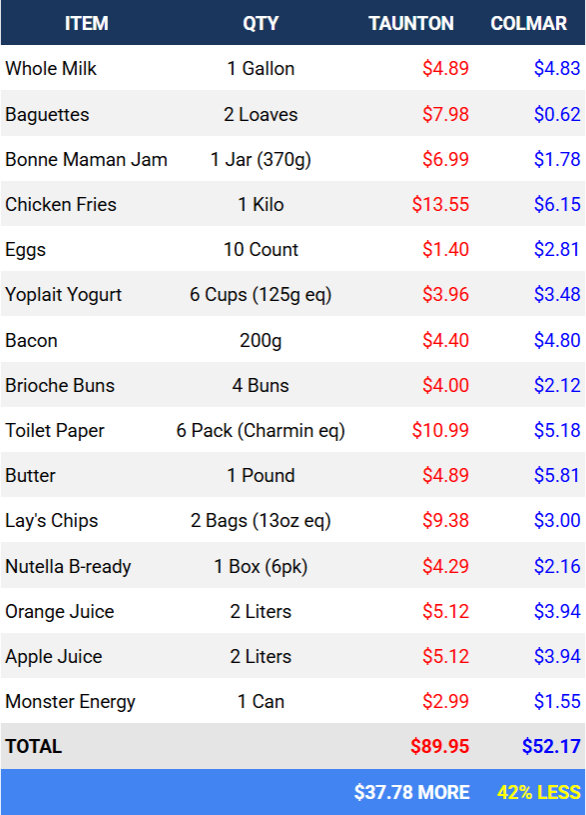
The trick is not “everything costs less.” The trick is that the food system seems to reward different behavior. Markets, bakeries, simple ingredients, less giant-box-store chaos, fewer insane portions, more daily-life shopping. If you fight that and insist on shopping like you are still in suburban America, you can absolutely make France expensive.
But when we leaned into how people actually shop there, the math looked better.
Not free.
Better.
That is the adult version of hope. Very dull. Very useful.
Transportation is where Colmar starts punching above its weight
This is where the comparison gets ugly for Taunton.
In Taunton, a car is not freedom. A car is life support with tires. If the car breaks, everything breaks. Work, appointments, groceries, kids’ activities, basic movement, all of it gets tied to a machine that eats gas, insurance, repairs, excise tax, registration, inspections, tires, brakes, and random mystery noises that cost $700 because a sensor had a feeling.
We have lived the broken-truck math and the one-car juggling act. It is exactly as fun as it sounds, which is to say not at all.
In Colmar, a single TRACE bus ride is listed at €1.50. A pack of 10 rides is €11. An adult monthly pass is €34, and the 5-to-25 monthly pass is €17. We paid €219 total for three months of bus access for one adult and two kids. That included the €5 Simplicités card fees we had to buy first.
| Cost | Amount |
|---|---|
| Total paid | €219 |
| Time covered | 3 months |
| People covered | 1 adult + 2 kids |
| Monthly family transit cost | €73/month |
| Per person per month | €24.33/month |
And we used those buses a lot.
That works out to about €73 a month for the three of us, or roughly €24.33 per person per month, including the card fees. Compare that with one tank of gas, one oil change, one small repair, one insurance payment, or one of those charming American car bills that arrives out of nowhere like a raccoon with a clipboard.
That is the difference people miss.
It is not just that the bus is cheaper than a car. Obviously it is. The shocking part is that the bus was actually useful.
We used it for normal life. Groceries. Getting around town. Going places without needing a car to be the center of every decision.
That does not mean you never need a car in France. Don’t kid yourself. France still has rural areas, bad weather, awkward schedules, heavy groceries, and places where transit exists mostly as a rumor with a timetable.
But in Colmar, the car did not feel like it had to sit in the middle of our lives like a four-wheeled landlord.
That changes the budget.
That changes stress.
That changes how much freedom your kids actually have.
Healthcare is where the American brain short-circuits
We paid full price in France. No Carte Vitale. No French public health coverage. No magic expat cheat code. Full price. No coupons and absolutely no shady clinics down dark alleys on the wrong side of town.
And it still felt less hostile than dealing with healthcare in the United States.
A standard GP visit in France is €30. That number is almost offensive when you are used to the American system, where even insured care can come with copays, deductibles, surprise bills, prescription nonsense, denial loops, and the fun little hobby of trying to figure out whether a bill is real or just medical-themed spam.
At one point back home, our medical copays were nearly $2,000 a month.
Not total healthcare spending.
Copays.
Nearly two grand a month after already having insurance, because apparently America looked at sick people and said, “What if this also had a billing labyrinth?”
France will not fix my body. My back is not going to cross the Atlantic and suddenly become a useful member of society. But the financial terror around care is different. Even before you get into reimbursements, mutuelles, or the full French system, the full-price starting point was not the same kind of threat.
That matters when you are trying to raise kids and not have every doctor visit feel like the opening scene of a bankruptcy documentary.
Housing is the number that needs fresh eyes every time
Housing is where I refuse to get cute.
When we searched Colmar rentals, we saw real listings that made Massachusetts look deranged. Three-bedroom places under €1,000. Even larger apartments showing up around that range. At one point, I saw a five-bedroom place near the back of Place Rapp for around €1,200 with a balcony over a courtyard.
That does not mean you can just show up and get one.
This is where people lie to themselves and then blame the country.
Listings are not leases. Availability changes. Landlords want documents. Foreign income complicates things. A family of four needs the right layout, the right school situation, the right transit access, and the right timing. Also, if a place looks too perfect, assume there is a reason, because buildings are old, heating matters, stairs matter, and charm has a maintenance bill.
Still, compare that with Taunton, where a three-bedroom rental can easily land around $3,000 a month, and suddenly the French numbers start looking less like fantasy and more like a math problem worth taking seriously.
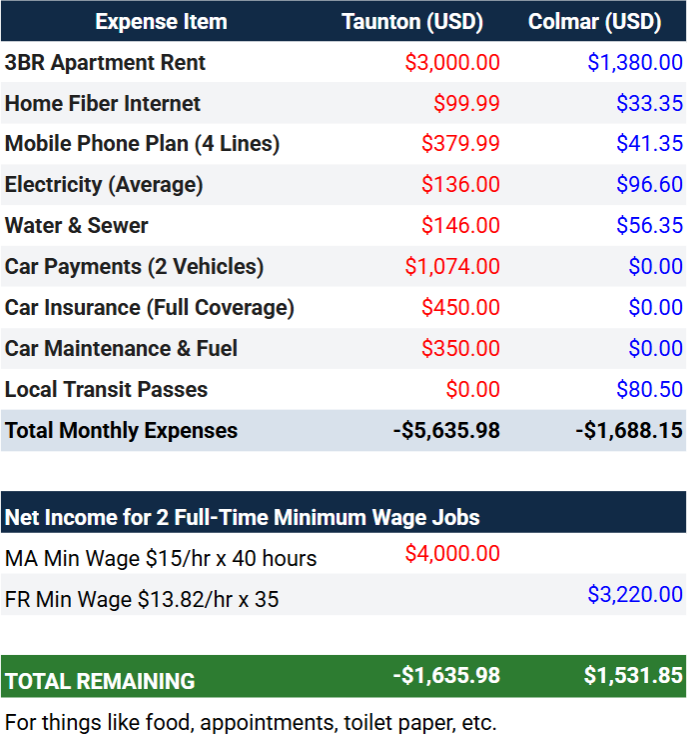
Not easy.
Serious.
There is a difference.
Daily life is not just cheaper. It is less rigged in certain places.
That is the real point.
I do not care if someone can find one expensive restaurant in Colmar and declare the whole comparison invalid. Of course tourist restaurants cost money. Of course meat can be expensive. Of course energy, repairs, taxes, bureaucracy, and bad decisions can eat your budget alive. France is a real country, not a coupon.
The question is whether the basic structure of daily life gives a normal family more room to breathe.
In Colmar, the answer looked like maybe.
Groceries could be lower if we shop like people who live there instead of like Americans trying to rebuild Target in our kitchen. Transportation could cost dramatically less if buses, trains, and walking replace even part of the car dependency. Healthcare, even at full price, felt less financially insane. Housing looked possible in a way that Massachusetts does not, at least for a family trying to survive without pretending average income means anything when minimum wage is all a worker is guaranteed.
That is why I keep comparing everything to minimum wage. Not average income. Not influencer income. Not remote tech salary. Minimum wage. The only wage you’re guaranteed to get if you can find a job at all.
The most important thing to take from the minimum wage comparison is that there is not one place in America that someone can live in their own safe apartment, plus afford food, utilities, transportation, and healthcare on minimum wage. Outside of huge expensive cities, in probably 98.7% of France, a single person can afford all of those things, and still go out for dinner from time to time, and even travel a bit.
If a place only works when you are lucky, rich, married to someone rich, or selling a course about how easy it is to move abroad, then it does not work for normal people.
Colmar was not perfect.
But it kept passing the tests that matter.
Can we eat?
Can we move?
Can we get care?
Can the kids function?
Can daily life happen without every normal need becoming a separate financial ambush?
That is the number I care about.
Not the price of one baguette.
The cost of breathing room.


One Response
The faster you leave the terrible us empire and its disgusting tax drone subjects, the better bro. The place is nothing more than hucksters, hustlers, and war mongering imperialists selling anglo saxon capitaliste, degenerate swill. Grifters and con artist usa