
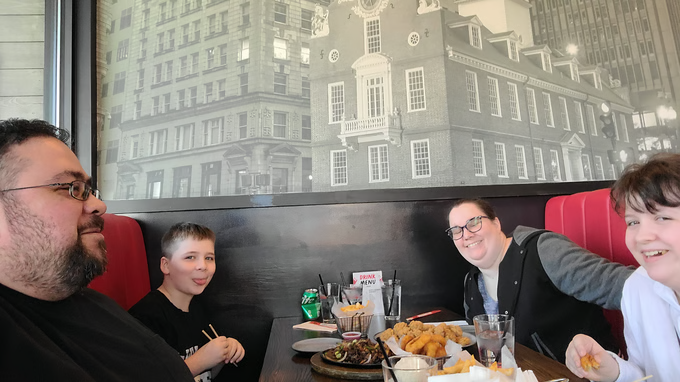
We’re a working-class American family with two children who spent two and a half months living daily life in Colmar, Alsace, France to see if a calmer, more functional system could actually work for people like us.
We’re not wealthy. We’re not retired. We didn’t chase trends, expat bubbles, or postcard France. We chose Alsace deliberately, and Colmar as a test, because it matched how we live, what we need, and what we want for our children: accessible healthcare, realistic education paths, and a life that doesn’t require constant crisis management.
This isn’t about escaping responsibility.
It’s about choosing a system that makes responsibility survivable.
Everything below explains why.
Amanda and Jonathan met on October 20, 2010, and clicked instantly, were engaged on October 20, 2011, and married on October 20, 2012. It wasn’t dramatic or mystical. It was recognition. Shared values, shared work ethic, and an understanding that stability only exists if you actively protect it.
Before we met, Jonathan already believed the United States was heading toward serious trouble. He saw it as both political and systemic. The system didn’t drift off course on its own. It was built through decades of political decisions that prioritized financial influence, corporate protection, and power retention over accountability to the public.
The country presents itself broadly as a democracy closely associated with freedom. In practice, it functions as a representative democracy, a form of political democracy where citizens elect representatives rather than decide policy directly. While representation exists formally, influence and outcomes are uneven and strongly shaped by money. Laws passed under those incentives don’t fade when politicians change. They harden into systems that continue operating regardless of who is in office.
Policies that allow tipped workers to be paid poverty wages even when no customers exist were political choices. Healthcare systems that tie survival to employment were political choices. Granting corporations greater legal protections than the people who work for them was a political choice repeated often enough to become structural. The result is a system that reliably protects institutions while shifting risk onto individuals and families.
When we met, Amanda didn’t see the country that way. She believed institutions still worked. Imperfectly, but fundamentally. She believed effort, responsibility, and playing by the rules still led somewhere livable. That belief wasn’t naïve. It was normal. It was reinforced by everyday life.
Over time, she watched that confidence erode. Not through ideology, but through experience.
When we met, Jonathan was working in a family auto repair business while also building a technology services company. He worked long hours, often multiple jobs at once. Disabled or not, he showed up. Sometimes that meant leaving one job site and driving a tow truck to another to fix a computer. The work wasn’t glamorous, but it mattered, and it was done well.
Amanda was working in a local bank and worked just as hard. She earned a better position at a large and still-growing company with strong benefits and constant pressure. The workload was relentless. The expectation was unlimited availability. Like many organizations, it hadn’t figured out that sustained overload doesn’t create loyalty. It creates exits.
She later moved into a city job, where she became a highly regarded employee and steadily advanced into the role of Head Administrative Clerk to the Treasurer. All of this while being a wife and a mother to two children. No shortcuts. No pauses. Just work.
Jonathan’s tech company was eventually selected for emergency-response contracts servicing hotels, hospitals, and government buildings. These were not optional calls. These were “everything stops if you don’t show up” calls. Business was strong. We bought 30 acres with plans to build a home. We bought a new Subaru. Old debts were finally being paid down.
We were doing what the American narrative says should work.
Then COVID happened. Now that was chaos.
Even before COVID, a critical imbalance already existed. Jonathan’s work paid more, but as a contractor it never included health insurance. Amanda’s job paid less, but it was considered “stable” and included coverage. That distinction outweighed income. It always does.
COVID didn’t create the problem. It exposed it.
When shutdowns hit, the work didn’t disappear. Hotels, hospitals, and government buildings didn’t suddenly stop having network problems. The work was consolidated, absorbed by larger vendors, and subcontracted through different layers. Jonathan’s role was cut out of the chain.
After COVID, Jonathan could not return to his previous work. The structure around the work had changed. At the same time, childcare options were limited, unreliable, or impossible.
Schools continued, but the quality of education deteriorated. Our children were already ahead academically. Sending them back would not have helped them move forward. It would have set them back. Education became inconsistent and diluted, so the decision was made to homeschool while Jonathan attempted limited remote work.
Instead of eliminating debt, we began accumulating it again. Productivity and effort did not translate into security. Access to healthcare depended not on need or contribution, but on how employment was classified.
This wasn’t personal failure. It was the system functioning exactly as designed.
We had planned to explore France years earlier. That plan was halted when Amanda’s sister suffered a massive ischemic stroke at 36. This has been ongoing since 2023.
Amanda became her legal guardian.
What followed has been grinding and relentless. Guardianship in the U.S. exists, but meaningful support for it is minimal. Amanda managed medical care, housing, finances, and legal obligations while working full time. Social Security approval took nearly two years.
Medicare will not begin until two years after that approval, despite the severity of the condition.
That’s right. It has been over two years so far, and the so-called greatest country in the world still will not provide coverage to a stroke victim.
Documentation has been endless. Care has been delayed or denied. Assets have been repeatedly inventoried. Every interaction treats necessity like suspicion.
When her sister lost her apartment, we were the ones who moved her belongings from over an hour away. We paid for everything with money saved to explore an Alsatian city. That time and money are gone. But we showed up. Family comes first.
During that period, Jonathan kept researching.
Healthcare systems. Education models. Transportation infrastructure. What happens to families after medical emergencies. What it means to try to be responsible inside systems that are rigid by design.
Jonathan has kyphosis, lordosis, and scoliosis. One doctor told him he probably wouldn’t be walking by 40. He is now 43 and still pushing his limits. That isn’t because of treatment, because treatment is routinely blocked. It’s because of perseverance, the inability to stop.
Doctors offer solutions. Insurance doesn’t like to pay. There is always another hoop. Try physical therapy again. Start over. Repeat. Coverage is denied not because care is unnecessary, but because delay is cheaper. How this is legal leads back to the same root problem. Corporate protections consistently outweigh human ones.
Amanda also had emergency back surgery. She lives with chronic pain as well. Insurance does not care about her pain either, and she can no longer see the doctor who performed her surgery.
By this point, stress wasn’t situational. It was constant. Health wasn’t something to manage occasionally. It was something to worry about all the time.
Most content about moving to France or Europe is created by people who are childless, privileged, or already retired. Their stories aren’t false, but they leave out a critical group.
Families.
Families do make this move. They’re just too busy surviving, working, and holding everything together to also record their findings and report back. We chose to document our experience so other families wouldn’t only see polished journeys that feel unreachable.
Nothing about what we’re doing is glamorous. It’s still worth it.
How We Chose Alsace
We didn’t choose Alsace because it’s the most famous part of France. We chose it because it isn’t.
Alsace has always stood apart. Geographically, it’s shaped by the Vosges Mountains. Culturally, it sits at the intersection of French and German influence. Historically, it has changed hands, languages, and identities more than once. As a result, it has developed a character that feels distinct from what many people picture when they think of “France.”
That difference mattered to us.
We weren’t looking for a single national identity or a romanticized idea of France built around Paris, the Riviera, or year-round tourism. We were looking for a region with its own rhythm, one where daily life comes first and history isn’t flattened into branding.
Alsace felt grounded. Practical. Rich in culture without being performative. Its towns function as places where people actually live, work, raise families, and grow old. The blend of French and German influence, layered over centuries of local tradition, felt more honest and more livable than the version of “France” most outsiders are sold.
We liked that it doesn’t try to be everything at once. It knows what it is.
That’s why we started there.
Once we focused on Alsace, the question became where within it made sense for us to test daily life.
We weren’t looking for the most popular city, the most internationally recognizable name, or a place already built around expatriates. We also weren’t looking for a medical desert, a resort economy, or a city that only works if you already have money, connections, or flawless language skills.
We were looking for a place that could reasonably represent life in Alsace.
Colmar fit that role.
It’s similar in scale to where we live now: a large town or small city, something similar to our home city of Taunton. That mattered. We didn’t want to compare a small American city to a major global hub and pretend the difference was purely cultural.
Colmar also allowed us to experience something fundamentally different from our current life: the ability to function day to day without depending on a car. That isn’t true everywhere in Alsace, but it is true in specific cities, and Colmar is one of them. It’s also well placed to connect to most of Europe, an added benefit!
Just as important, Colmar isn’t defined by tourism alone. It has visitors, yes, especially for the Christmas Markets, but it also has schools, hospitals, markets, transit, and neighborhoods that operate for residents first. Daily life isn’t an afterthought.
Colmar wasn’t chosen as a final answer. It was chosen as a test case. A way to live inside Alsace rather than observe it from the outside, and to see whether the region itself made sense for our family.
It did and it does. Sweet like croissants!
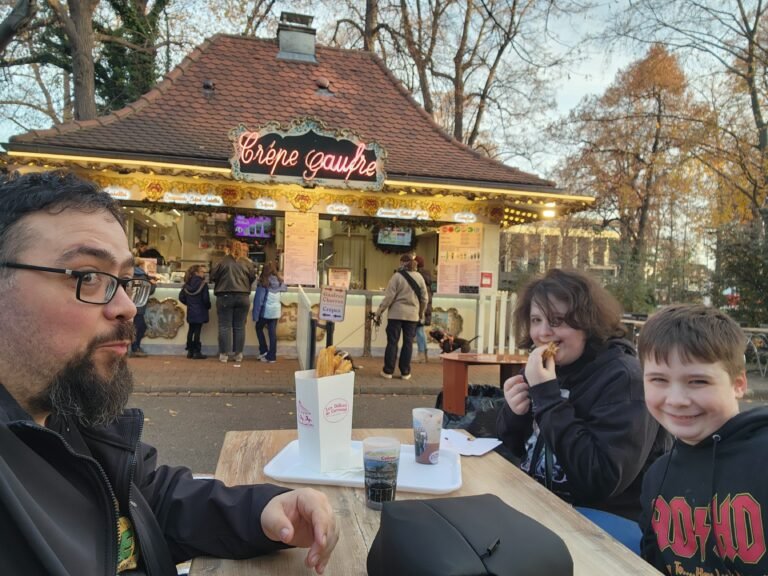
We spent 78 days in France. 76 days in Colmar sandwiched with single days in Paris at the beginning and end.
Seventy of those days were just Jonathan, Sylvie, and Rhys exploring and experiencing daily life.
Amanda visited for 8 days over Christmas and lost nearly all of them to influenza contracted from work.
The first day was Paris. We saw the Arc de Triomphe and the Eiffel Tower. It was crowded, busy, and not what we were looking for. We can honestly say we visited Paris. We can also honestly say it wasn’t for us.
The rest of the time was about ordinary living. We walked, shopped, cooked, and paid attention. We visited the capital of the European Union, Strasbourg, Munster, Niedermorschwihr, Freiburg Germany, and Basel Switzerland, to name a few. Such diversity, all within an hour from Colmar.
Jonathan did all of this while dealing with a pinched nerve a doctor said could not be treated. Even so, he walked as much as he could. Enough to feel how differently daily life is structured. The pain was unending, but the experience was still worth it. That says a lot.
What stood out wasn’t theory anymore. It was observation. Children walked to school. Families ate lunch outside. Life moved without constant urgency. And for the first time, university felt like a realistic, affordable outcome instead of a debt sentence.
We haven’t moved yet.
We’re still stuck in a hypocritical system of giving free meals to the rich and charging double for the scraps.
We need to sell our belongings, including our house. Maintain a local address. Apply for visas. Schedule a one-way trip. Say goodbye.
None of this is romantic. It’s procedural.
When we return to Alsace, whether it be Colmar, Strasbourg, or somewhere in the middle like Selestat, it will feel like progress. Not because life will be easy, but because it won’t be defined by constant crisis management.
This is a vlog, sure. But it’s also documentation and a resource.
It exists to show what it actually takes for a working-class family with children, real constraints, and no safety net to find a system that aligns better with their lives.
This is for the children.
Our children.
Your children.
Children growing up in a country where stability increasingly depends on money rather than effort.
Children who should be able to pursue higher education regardless of how rich or poor their parents are, and who should not be sentenced to decades of crushing debt for the offense of wanting to learn.
Children who may face health problems later in life and deserve real care without having to beg, justify their worth, or negotiate with insurance companies while in pain.
Children deserve systems that treat their futures as something to be protected, not monetized.